Destination Guides
Best Time to Visit Malaysia: Monsoons, Islands and Events by Month
Malaysia has two opposite monsoon clocks: December-March suits Langkawi and Penang on the west coast, while April-September is when the Perhentian, Redang and Tioman islands are actually open.
بقلم Noushad Eranniyan10 دقائق قراءة
في هذه الصفحة · 12 قسمًا
- Malaysia's three climates, not one
- The Cameron Highlands: Malaysia's cool-climate break
- Haze: Malaysia's own smoke season
- Malaysia's 2027 calendar: Ramadan, Thaipusam and the big festivals
- School holidays and when it gets busiest
- When UAE school holidays line up with Malaysia
- Getting to Malaysia from the UAE
- Visa and the MDAC
- Before you go
- Frequently asked questions
- Plan your Malaysia trip with Holidayys
- Related guides
The short answer: Malaysia runs on two different monsoon clocks. On the west coast (Kuala Lumpur, Penang, Langkawi, Malacca), December to March is the driest, sunniest stretch for Langkawi and Penang specifically, while April-May and October-November bring the heaviest rain. On the east coast (the Perhentian, Redang and Tioman islands), the north-east monsoon shuts most resorts and ferries from roughly November to February, so April to September is the window there instead. Borneo (Sabah and Sarawak) follows a closer-to-year-round pattern tied to the same monsoon, without the west coast's sharp dry spell. Kuala Lumpur itself, being inland, never gets a fully dry month either way.
| Month | Kuala Lumpur avg. high / low (°C) | KL rainfall | Langkawi & the east coast |
|---|---|---|---|
| January | 32.6 / 23.8 | 227mm | Langkawi/Penang dry season; east coast resorts still closed |
| February | 33.3 / 24.0 | 193mm | Best west-coast month; east coast mostly still closed |
| March | 33.7 / 24.5 | 270mm | West-coast dry season ending; east coast reopening |
| April | 33.7 / 24.7 | 302mm | Inter-monsoon rain picks up on the west coast; east coast season begins |
| May | 33.6 / 25.0 | 230mm | East coast islands open and good; durian season begins |
| June | 33.3 / 24.8 | 146mm | Good on both coasts; peak durian season |
| July | 32.8 / 24.4 | 165mm | Good on both coasts; haze risk window opens |
| August | 32.8 / 24.5 | 174mm | Good on both coasts; haze risk continues; Merdeka Day, 31 August |
| September | 32.7 / 24.2 | 220mm | Good on both coasts; haze risk tails off |
| October | 32.6 / 24.2 | 284mm | Inter-monsoon rain returns on the west coast; east coast season ending |
| November | 32.3 / 24.1 | 356mm (wettest) | North-east monsoon sets in; east coast resorts closing |
| December | 32.0 / 24.0 | 281mm | Langkawi/Penang dry season begins; east coast closed |
Kuala Lumpur figures are the 1991-2020 climate normals for Sultan Abdul Aziz Shah Airport (Subang), the World Meteorological Organization's standard reference set for the city. Malaysia's own Meteorological Department (MetMalaysia) publishes the monsoon season descriptions used throughout this guide, but not a public month-by-month normals table we could fetch directly, so the numbers above are the WMO set and the seasonal pattern is MetMalaysia's. Notice that KL's own rainfall doesn't show a sharp dry season the way Langkawi and Penang do: the "west coast dry season" is really about wind exposure on the coast and islands, not about the capital's rain gauge.
Malaysia's three climates, not one
The west coast: Kuala Lumpur, Penang, Langkawi, Malacca
This is the Malaysia most UAE visitors see first. Langkawi and Penang, both coastal and more exposed to the monsoon winds than inland KL, have a genuine dry season from December to March: calmer seas, less rain, and the best beach and island-hopping weather of the year. April-May and October-November, the inter-monsoon periods, are the wettest stretch, with KL's own figures showing November as the wettest month on record. Malacca, further south, follows a broadly similar pattern.
The east coast: Perhentian, Redang, Tioman
The east coast runs on the opposite clock. The north-east monsoon brings heavy seas and rain from roughly November to February, and most resorts and ferry operators on the Perhentian Islands close for the season rather than try to run through it; a handful of properties reportedly stay open, so confirm directly with the resort. April to September is the recommended window, with calm, clear water best for diving and snorkelling once the season is under way.
Borneo: Sabah and Sarawak
Sabah (Kota Kinabalu, Mount Kinabalu) and Sarawak sit under a more equatorial pattern than the peninsula, without as sharp a split between wet and dry. The same north-east monsoon still brings the wettest spell here too, roughly November to February, also when a Mount Kinabalu climb is more likely disrupted by rain and cloud on the summit trail. March to October is generally the steadier window, though rain is possible in any month; treat this as a general pattern, since Borneo's own climate data is less widely published than the peninsula's.
The Cameron Highlands: Malaysia's cool-climate break
Up at 800 to 1,600 metres, the Cameron Highlands run a genuinely different climate from the lowlands: a mean annual temperature around 18°C, daytime highs that rarely clear 25°C, and nights that can drop to single figures at the higher elevations. January is the driest month on record there and October the wettest, broadly the same pattern as the lowlands, just cooler across the board. It's a popular one- or two-night add-on to a KL trip for the tea plantations and strawberry farms, and worth packing a light jumper or fleece for whatever month you go.
Haze: Malaysia's own smoke season
Like Singapore, Peninsular Malaysia gets occasional smoke haze from land and forest fires in Sumatra and Indonesian Borneo, carried over by the south-west monsoon winds. It's worst in dry years, typically from around July to October, and far from guaranteed every year. If you're travelling in this window, check the news in the days before you fly rather than building a contingency plan months in advance; a bad haze spell is usually short-lived.
Malaysia's 2027 calendar: Ramadan, Thaipusam and the big festivals
Ramadan and Hari Raya Aidilfitri
Ramadan 2027 is expected to run from around 8 February to 9 March, with Hari Raya Aidilfitri (Eid al-Fitr) expected around 10 March, close to the UAE's own expected Eid Al Fitr dates. Expect quieter daytime streets and shorter restaurant hours during Ramadan itself, and a genuinely festive atmosphere with open houses and markets in the run-up to Hari Raya.
Chinese New Year
Chinese New Year 2027 falls on Saturday 6 February, the same date as Singapore's and the wider region's, since both follow the lunar calendar. Expect George Town in Penang and KL's Chinatown to be decorated and busy for weeks either side of the date.
Thaipusam at Batu Caves
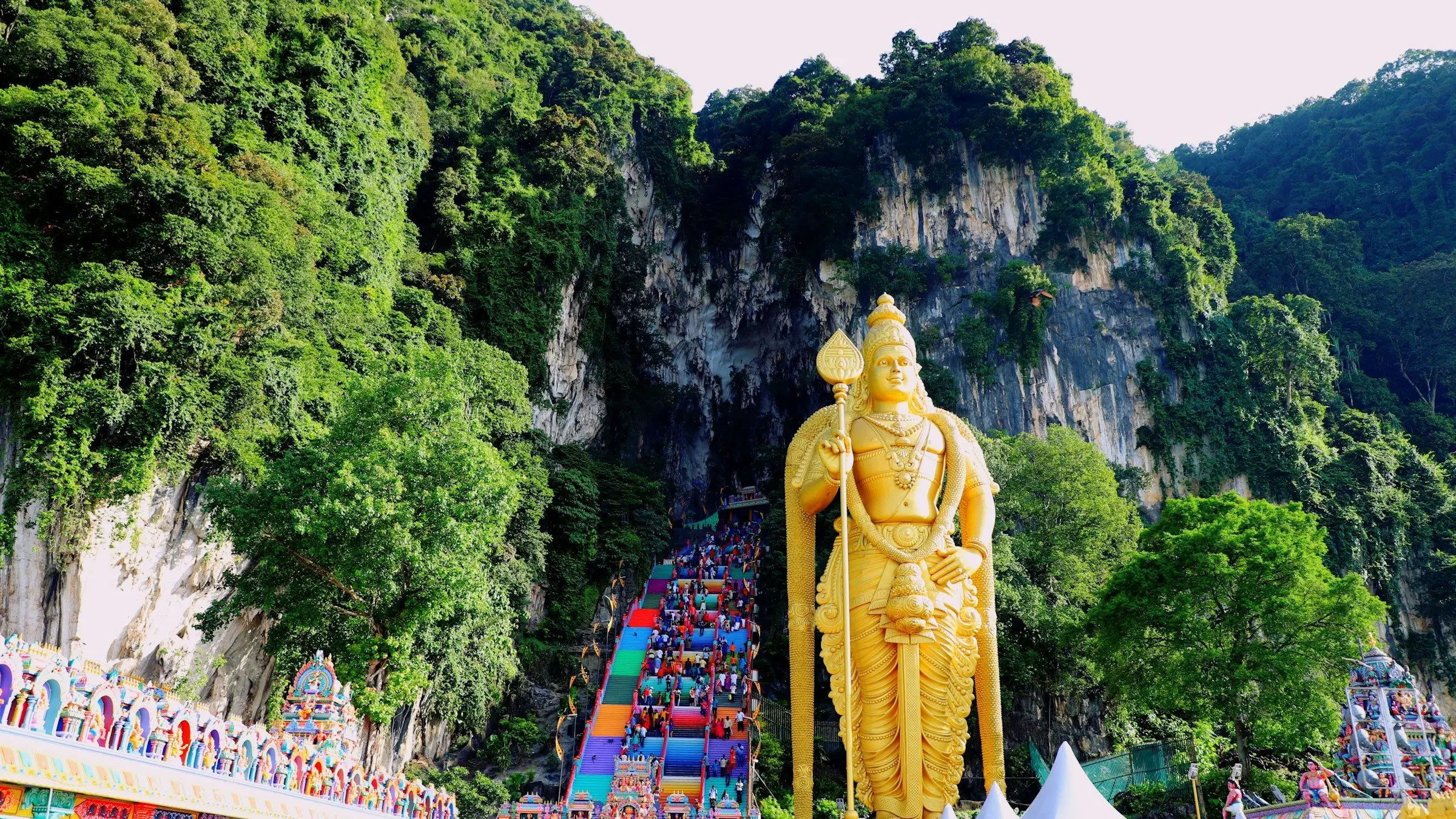
Thaipusam, the Tamil Hindu festival marked by the kavadi procession to Batu Caves outside KL, is expected around 22 January 2027, falling on the full moon of the Tamil month of Thai. It's one of the most striking sights on the Malaysia calendar if your dates line up, but also one of the busiest days of the year at Batu Caves, so expect crowds and plan your transport to the site well in advance.
Deepavali and Hari Raya Haji
Deepavali 2027 is currently expected around late October, and Hari Raya Haji (Eid al-Adha) around mid-May, close to the UAE's own expected Eid Al Adha window. Both are public holidays in Malaysia, and both dates move slightly year to year, so confirm closer to your travel dates.
Durian season
Peninsular Malaysia's main durian season generally runs June to August, when stalls and dedicated durian feasts pop up around KL and Penang. It's worth timing a trip around if that's your reason for going; outside that window, durian is usually still available but at a premium and less reliably at its best.
School holidays and when it gets busiest
Malaysia's own school calendar runs four term breaks a year, roughly in March, late May to early June, late August to early September and December, which push up domestic demand for Langkawi, Penang and the Genting and Cameron Highlands in particular; exact 2027 dates had not been published by Malaysia's Ministry of Education when we checked. For UAE travellers, the busiest windows are Malaysia's own December and school-holiday weeks layering onto the UAE's winter break, and Chinese New Year, when KL's Chinatown and Penang's George Town get genuinely crowded alongside the rest of the region.
When UAE school holidays line up with Malaysia
| UAE break | 2026/27 dates | Malaysia at that time |
|---|---|---|
| School winter break | 14 December 2026 to 3 January 2027 | Langkawi/Penang dry season just starting; east coast islands closed; also Malaysia's own school holidays, so expect crowds |
| Spring break (end of Term 2) | Around 5 to 11 April 2027 for most Dubai and Ministry of Education schools | West-coast wet season building; east coast islands open and good |
| Summer school holidays | Roughly July to August | Good on both coasts; peak durian season; some haze risk |
Getting to Malaysia from the UAE
Emirates flies non-stop from Dubai to Kuala Lumpur, and Etihad flies non-stop from Abu Dhabi, both in around six and a half to seven and a half hours. Air Arabia flies non-stop from Sharjah to Kuala Lumpur, and flydubai flies non-stop from Dubai direct to Penang, useful if the west coast beaches are your main reason for going rather than the capital. Malaysia Airlines no longer flies the Dubai route.
Visa and the MDAC
Entry rules depend on your passport rather than your UAE residence. Indian and Filipino passport holders currently travel visa-free for up to 30 days (India's exemption runs until 31 December 2026, with 2027 not yet confirmed at the time of writing), Emiratis travel visa-free too, and Pakistani, Bangladeshi and Sri Lankan passport holders need an eVisa arranged before they fly. Whatever your passport, almost everyone must also fill in the free Malaysia Digital Arrival Card (MDAC), submitted online at the official MDAC portal within three days before arrival. For the full breakdown by nationality, see our Malaysia visa for UAE residents guide, or use our Malaysia visa service.
Before you go
- Pick your coast before you pick your month. December-March suits Langkawi and Penang; April-September suits the Perhentian, Redang and Tioman islands. Trying to do both on one trip in the wrong season means one half disappoints.
- Pack a light layer for the Cameron Highlands even in the hottest months elsewhere; the hill air is genuinely cool after Dubai or KL.
- Book island resorts and ferries early for peak weeks, especially the UAE winter break and Chinese New Year, when UAE and Malaysian school holidays can land close together.
- Submit your MDAC before you fly, not at the airport: it's free and takes a few minutes online, but immigration queues move faster for travellers who've already done it.
- Carry a return ticket and hotel booking regardless of your visa status; Malaysian immigration can ask to see them on arrival.
Frequently asked questions
What is the best time to visit Malaysia from the UAE?
There's no single best month, since Malaysia has three different climate zones. December to March suits Langkawi and Penang on the west coast, April to September suits the Perhentian, Redang and Tioman islands on the east coast, and Borneo is generally steadier from March to October.
Is Malaysia's east coast closed in winter?
Largely, yes. The north-east monsoon brings heavy seas and rain from around November to February, and most resorts and ferries on the Perhentian, Redang and Tioman islands close for the season rather than operate through it.
When is Chinese New Year in Malaysia in 2027?
Chinese New Year 2027 falls on Saturday 6 February, the same date as Singapore's and the wider region's, since it follows the lunar calendar.
Do I need to fill in the MDAC if I already have a Malaysia visa?
Yes. The MDAC is a separate, free online arrival form required of almost every visitor regardless of visa status, submitted within three days before you land; it isn't replaced by holding a visa or a visa exemption.
How long is the flight from Dubai to Kuala Lumpur?
Emirates flies non-stop from Dubai to Kuala Lumpur in around six and a half to seven and a half hours; Etihad flies the same route non-stop from Abu Dhabi.
What is durian season in Malaysia?
Peninsular Malaysia's main durian season generally runs June to August, when stalls and durian feasts are easiest to find around Kuala Lumpur and Penang; it's available outside that window too, just less reliably at its best.
Plan your Malaysia trip with Holidayys
We book Malaysia trips to suit whichever coast you want: our Malaysia package covers KL, Batu Caves and Langkawi island-hopping in one trip, our Kuala Lumpur and Langkawi package splits the time more evenly between the city and the beach, and our Malaysia and Singapore package adds Singapore with the coach link between the two. We also handle the visa alone, and can arrange your hotel and flights around any of the dates above. Message us on WhatsApp +971 4 589 0001 or use our contact page.
Related guides
- Malaysia visa for UAE residents
- Places to visit in Malaysia
- Best time to visit Singapore
- Where to travel in January from the UAE
- Best places to visit in December from the UAE
Last checked 4 November 2026 against the World Meteorological Organization's climate normals for Kuala Lumpur (Sultan Abdul Aziz Shah Airport, 1991-2020), Malaysia's Meteorological Department's published monsoon descriptions, Wikipedia's sourced entries for the Perhentian Islands and the Cameron Highlands, the official Malaysia Digital Arrival Card portal, and holidayys.com's own checked Malaysia visa guide for flight routes and the MDAC rule. Malaysia's 2027 festival dates (Thaipusam, Deepavali, Hari Raya Haji), its 2027 school holiday calendar and Borneo's exact seasonal pattern had not been officially published or independently confirmed when we checked, and durian season is drawn from general, non-official reporting rather than a single authoritative source; confirm all of these closer to your travel dates.
- Malaysia
- Weather
- UAE Residents
- Monsoon Season
- Travel Tips