Travel Tips
Dubai to Salalah by Road: Distance, Routes and Khareef Season
Dubai to Salalah by road is about 1,200 km and 12–16 hours via Al Ain. Routes, fuel stops, khareef season dates (21 June–21 September) and what to see.
By Noushad Eranniyan8 min read
On this page · 12 sections
- Dubai to Salalah at a glance
- Route options: Al Ain, Hatta or via Muscat
- The long stretch through Al Wusta
- Road conditions, speed limits and driving after dark
- What your car needs to cross into Oman
- When to go: khareef season or the dry season
- What to see around Salalah
- Flying or taking the bus instead
- Entry rules for UAE residents
- Plan your Salalah trip with Holidayys
- Frequently asked questions
- Related guides
The short answer: the direct inland drive from Dubai to Salalah, crossing south of Al Ain and running through Ibri, Adam, Haima and Thumrait, is about 1,200 km and takes 12 to 16 hours on the road, not counting stops or the border. Routing the trip through Muscat itself adds distance, since the capital sits well off the direct line; expect closer to 1,450 km and 14 to 17 hours that way. You will need a passport valid for six months, an Oman visa (unless your passport is visa-free or you hold GCC nationality), car insurance valid in Oman, and the UAE's AED 35 per person exit fee. Most people make the trip for khareef, Dhofar's monsoon season, which runs roughly 21 June to 21 September.
Dubai to Salalah at a glance
| Direct (via Al Ain) | Via Muscat | Flying | Bus | |
|---|---|---|---|---|
| Distance | About 1,200 km | About 1,450 km | About 920 km in the air | Two separate legs |
| Travel time | 12–16 hours driving | 14–17 hours driving | About 2 hours | Roughly 18–20 hours in total |
| Border | Mezyad–Hafeet, south of Al Ain | Usually Hatta–Al Wajajah | Airport immigration | Same land border, on a coach |
| Who it suits | Drivers happy to split the trip over two days | Anyone breaking the journey in Muscat | Short khareef weekends | Travellers without a car, in no rush |
| Main thing to plan for | The long fuel gap after Haima | City traffic through Muscat | Fares rise in khareef season | No single through-ticket from Dubai |
Route options: Al Ain, Hatta or via Muscat
Every inland route to Salalah eventually joins the same desert highway south of Nizwa, so the border you pick mostly decides how the first few hours feel.
Via Al Ain (Hafeet–Mezyad)
From Dubai, the E66/E22 road runs to Al Ain, where the Mezyad–Hafeet crossing takes you into Oman on the road to Ibri. It also suits drivers coming from Abu Dhabi. From Ibri the road runs on towards Adam, where it joins the desert highway south.
Via Hatta
The Hatta–Al Wajajah crossing is about 130 km from Dubai. Beyond it the road drops to Oman’s Batinah coast, so this crossing makes most sense if you plan to stop in Muscat on the way south. Hatta also sees heavy weekend traffic from day-trippers, so expect queues at the gate on Thursday and Friday mornings.
Taking it through Muscat
Some drivers prefer to break the trip in Muscat rather than bypass it, especially on a first visit, sightseeing in the capital before continuing south on Route 31 past Nizwa, Adam and Thumrait. It adds a few hours and roughly 250 km over the direct line, but it turns a long single push into two more comfortable days.
The long stretch through Al Wusta
South of Nizwa, the road runs through Adam and into Al Wusta governorate, where towns thin out fast. Haima is the last proper service stop with fuel, food and basic accommodation before a genuinely empty run. Several UAE travel guides flag the Haima-to-Thumrait leg, around 400–440 km, as the longest without reliable fuel; the only stop in between is Qitbit, roughly 220 km south of Haima, which has an older petrol station and a motel whose opening hours are not consistent. Fill up fully in Haima, carry drinking water, and do not assume Qitbit will be open.
Thumrait itself sits on Highway 31 about 90 km north of Salalah and makes a sensible last break before the final run into the city, with fuel and a small hotel near the main junction.
Road conditions, speed limits and driving after dark
Oman's expressways carry a 120 km/h limit, dropping to 100 km/h or lower near towns and to as little as 80 km/h on signed bends; the Royal Oman Police enforces these with fixed and mobile speed cameras, and downhill stretches in the Dhofar mountains make it easy to drift over the limit unnoticed. South of Adam the road is mostly single carriageway shared with heavy freight, so overtake with care on the long straight sections.
Camels are the main after-dark hazard: Oman records dozens of vehicle-camel collisions a year on unlit desert roads, and the animals often freeze rather than move when headlights catch them. Fog can also drop visibility sharply on the hills approaching Dhofar, near Wadi Dawkha, where UAE residents who have made the drive advise fog lights and low beams rather than main beams. The common advice from residents who do this trip often: split it over two days, start early, avoid driving after sunset in the mountains, and have the car serviced and its tyres checked first, since khareef season leaves parts of the route wet.
What your car needs to cross into Oman
The paperwork matches any UAE–Oman land crossing, covered in more detail in our guide to driving or busing to Oman. In short: your UAE motor insurance may already extend to Oman, so check with your insurer and carry the certificate; if not, short-term Omani cover is sold at the border. A financed or company car needs a letter of permission, and a rented car needs the rental firm's written consent plus Oman cover, which many UAE firms do not offer at all, so ask before you book. Each traveller also pays the UAE's AED 35 exit fee at the border, on top of any Oman visa fee.
When to go: khareef season or the dry season
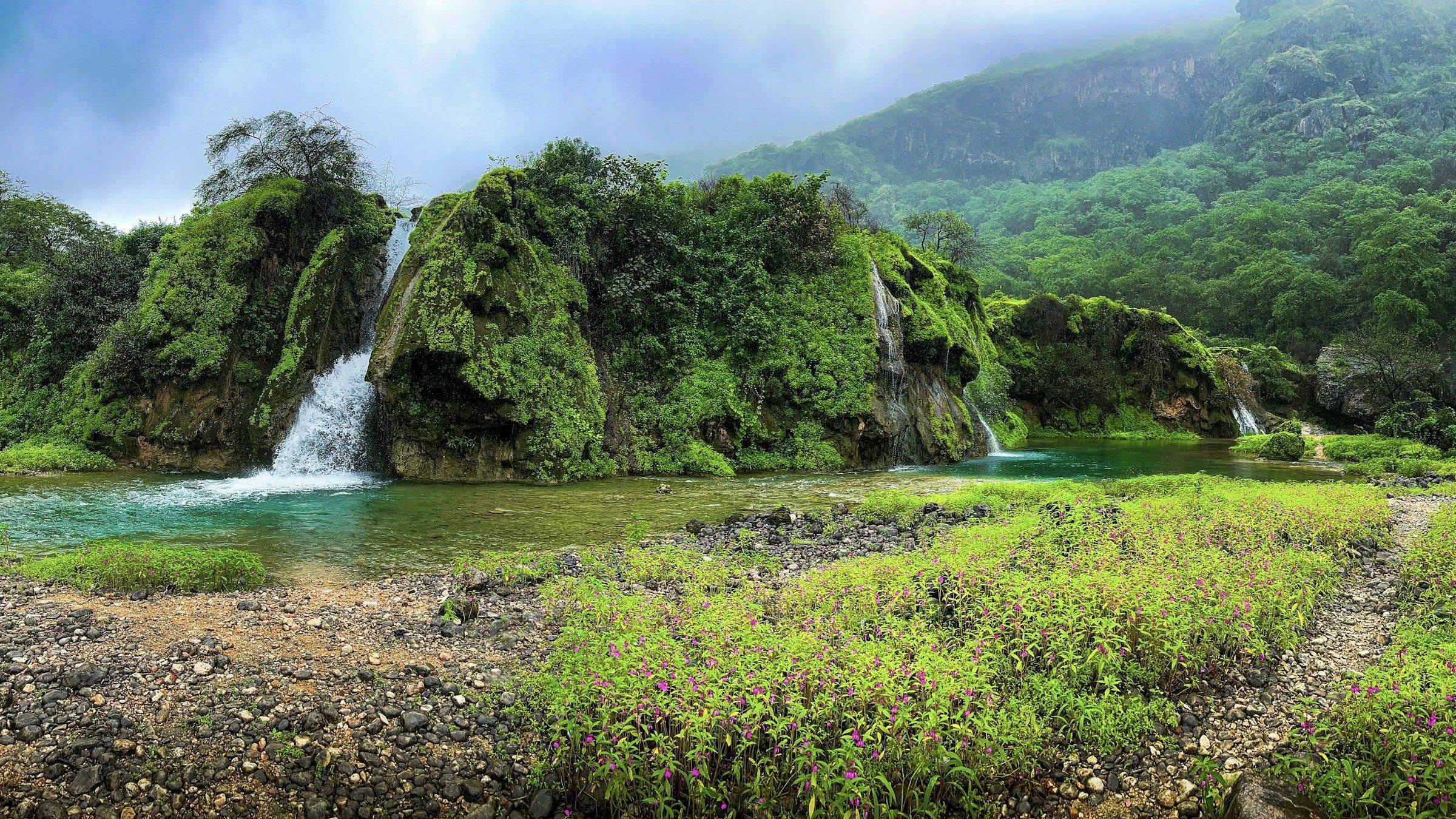
Most of Salalah's road-trip traffic from the UAE is timed around khareef, the Arabic word used locally for Dhofar's summer monsoon. A cool, moist southwest wind off the Arabian Sea wraps the Dhofar mountains in mist and light drizzle for weeks at a time, turning the hills around Wadi Darbat and Jabal Samhan green while the rest of the Gulf bakes. Daytime temperatures through the season typically sit in the low to high 20s °C, against the mid-40s further north. Oman's 2026 khareef season ran officially from 21 June to 21 September, tied to the summer solstice rather than a fixed calendar date each year, so 2027 should fall on close to the same dates. Dhofar's municipality usually times a season of cultural events, exhibitions and a tourism festival (often called the Ittin or Salalah Tourism Festival) to run for several weeks within that window, though the exact dates are confirmed only a month or so beforehand.
Outside khareef, October to April is Salalah's dry season: warm, mostly clear days in the high 20s to low 30s °C, calmer roads, and none of the fog that slows the final stretch into Dhofar during the monsoon. It suits the drive itself better, even if the hills stay brown rather than green.
What to see around Salalah
- Wadi Darbat, east of Salalah, holds water year-round and runs small waterfalls in khareef; boat rides and lakeside trails are the main draw.
- Ain Athum, a monsoon-fed waterfall off Route 47, needs khareef rainfall to run and suits a 4x4 on its slippery final approach.
- Mughsail, west of the city, is known for its blowholes, where spray forces up through the rock on a day with some surf, plus a long beach and the Al Marnif cave above it.
- Taqah, with its old castle and the Khor Rori archaeological site nearby, sits on the coast toward Mirbat.
- Jabal Samhan, inland and higher up, gives mountain viewpoints that fill with mist during khareef.
- Al Baleed Archaeological Park and the Museum of the Frankincense Land, about 5 km from the centre, cover the frankincense trade on this coast, inside a UNESCO World Heritage site.
- The Anti-Gravity Point, on the road between Taqah and Mirbat, is a stretch where a car left in neutral appears to roll uphill, an optical effect of the surrounding terrain.
Flying or taking the bus instead
flydubai flies non-stop between Dubai and Salalah in around 2 hours, several times a week, and is the only realistic option if you want more than a long weekend in Dhofar without losing a day each way on the road. There is no direct bus from Dubai to Salalah. Oman's state operator Mwasalat runs a Muscat–Salalah service, so travelling by bus from the UAE means first reaching Muscat, by the Dubai–Muscat coach covered in our Oman road-trip guide, then changing onto the Mwasalat service south, a combined trip of around 18 to 20 hours. We could not confirm Mwasalat's current Muscat–Salalah fare or timetable; check mwasalat.om directly before relying on it.
Entry rules for UAE residents
Most UAE residents need an Oman visa before crossing by road, whether or not they are flying. GCC nationals cross visa-free, and some resident professions qualify for a cheaper visa-on-arrival at the land border; everyone else applies for a standard tourist e-visa in advance. The rules, fees and which professions qualify change from time to time, so check our Oman visa guide for UAE residents or go directly to our Oman visa service before you travel.
Plan your Salalah trip with Holidayys
We do not currently sell a fixed Salalah package, but we put together custom Salalah trips on request: flights, hotel and a local driver or day tours around Wadi Darbat, Mughsail and the Dhofar mountains, built around your dates and khareef or dry-season preference. If you would rather tour somewhere else in the region first, our holiday packages page covers our ready-made trips. For a Salalah quote, message us on WhatsApp at +971 4 589 0001 or use the contact page.
Frequently asked questions
How far is Salalah from Dubai by road?
About 1,200 km on the direct inland route via Al Ain and Ibri. Routing through Muscat adds roughly 250 km, since the capital is off the direct line.
How long does the drive from Dubai to Salalah take?
Figures from UAE travel guides range from 12 to 16 hours of driving on the direct route, and most residents split it into two days rather than driving straight through.
What is khareef season in Salalah?
Khareef is Dhofar's summer monsoon, a cool, misty southwest wind that greens the mountains around Salalah while the rest of the Gulf is hot and dry. The 2026 season ran officially from 21 June to 21 September, and 2027 should fall on close to the same dates.
Can I fly directly from Dubai to Salalah?
Yes. flydubai operates non-stop flights between Dubai and Salalah, taking around 2 hours, several times a week.
Do I need a visa to drive from the UAE to Oman?
Most nationalities do, unless you hold GCC citizenship or your passport is visa-free for Oman. Some UAE residents qualify for a cheaper visa-on-arrival depending on their profession; others need a standard tourist e-visa arranged before travel.
Is the road from Dubai to Salalah safe to drive at night?
It is best avoided, especially in the Dhofar mountains near the end of the trip. Camels straying onto unlit roads are the main hazard, and khareef-season fog can cut visibility sharply on the final stretch. Most residents who do this drive recommend finishing each day's driving before dark.
Related guides
- Dubai to Oman by bus or car
- Oman visa for UAE residents
- Musandam trip from Dubai
- Holiday packages from Dubai
Last checked 9 October 2026 against UAE and Omani road-trip guides (Bayut, Dubizzle, Property Finder, LNK Oman), Oman Observer and Times of Oman reporting on the 2026 khareef season and Royal Oman Police enforcement, flydubai's route pages, and Khaleej Times' road-safety advice for the Dubai–Salalah drive. Distances, fuel-stop conditions, visa fees and festival dates change; confirm them before you travel.
- Oman
- Road Trip
- Salalah
- UAE Residents