Destination Guides
Places to Visit in Uzbekistan: Tashkent, Samarkand, Bukhara and Khiva
Uzbekistan's route runs Tashkent to Samarkand, Bukhara and Khiva, linked by the Afrosiyob train (just over 2 hours Tashkent-Samarkand), with entry fees and a 5-7 day plan.
By Noushad Eranniyan13 min read
On this page · 14 sections
- Uzbekistan at a glance
- Where to go in Uzbekistan: the main places
- Things to do in Tashkent
- Samarkand: the Registan and beyond
- Bukhara's old city
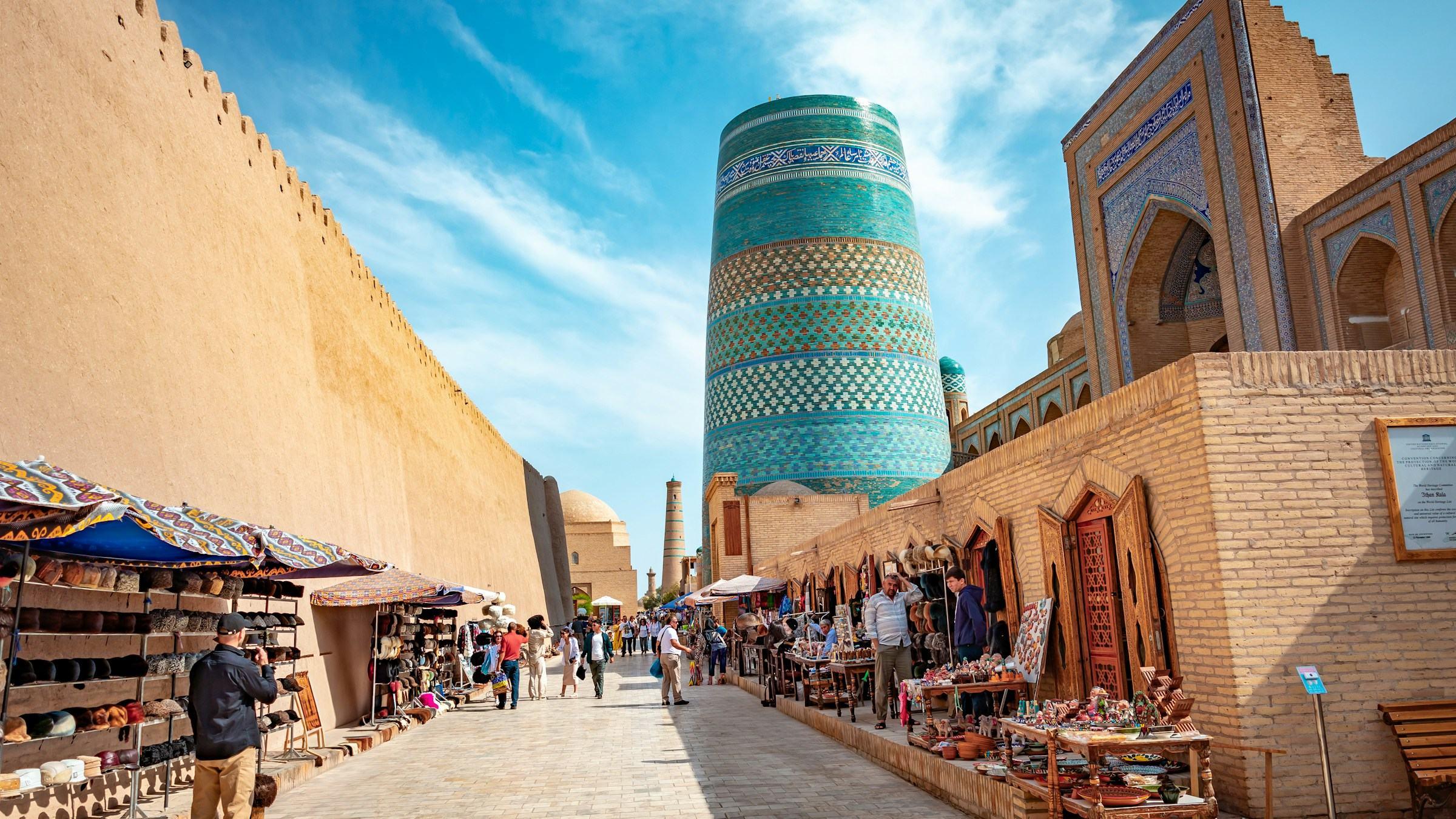
- Khiva: the walled city of Itchan Kala
- Day trips: Chimgan, Charvak and Shahrisabz
- Getting between the cities: the Afrosiyob train
- Best time to visit Uzbekistan, month by month
- A 5 to 7-day Uzbekistan route
- Flights from the UAE to Uzbekistan
- Frequently asked questions
- Plan your Uzbekistan trip with Holidayys
- Related guides
The short answer: Uzbekistan's Silk Road route runs Tashkent, the modern capital, to Samarkand (Registan, Shah-i-Zinda, Gur-e-Amir), Bukhara's old city and Khiva's walled Itchan Kala, with the high-speed Afrosiyob train covering Tashkent to Samarkand in just over 2 hours. flydubai flies non-stop to Tashkent in about 3 hours 25 minutes, and also to Samarkand; Air Arabia and Etihad serve Tashkent too. A 5 to 7-day route covers the first three cities comfortably, with Khiva needing extra days or a domestic flight. Our National Day package covers Samarkand, Bukhara and Khiva over 7 days and 6 nights from AED 3,499, departing 2 December 2026.
This guide is for UAE residents planning a first Uzbekistan trip: where to go, what each place costs to enter, how to move between cities on the Afrosiyob train, and when to go. It assumes you are flying out of Dubai, Sharjah or Abu Dhabi and starting in Tashkent, which is how nearly every Gulf itinerary begins.
Uzbekistan at a glance
| Uzbekistan from the UAE | |
|---|---|
| Flight time | About 3 hours 25–30 minutes non-stop to Tashkent on flydubai; flydubai also flies direct to Samarkand |
| Visa | Most UAE residents need an e-visa; Emirati citizens enter visa-free for up to 30 days – see our Uzbekistan visa guide |
| Best months | April–May and September–October; avoid July, the hottest month, especially in Bukhara |
| Currency | Uzbek som (UZS) |
| Getting between cities | The Afrosiyob high-speed train links Tashkent, Samarkand and Bukhara; book on railway.uz or at the station |
| Our package | 7D/6N from AED 3,499 per person, departing 2 December 2026, covering Samarkand, Bukhara and Khiva |
Where to go in Uzbekistan: the main places
| Place | From Tashkent | Best for |
|---|---|---|
| Tashkent | – | Khast Imam complex, Chorsu Bazaar and the metro's showcase stations |
| Samarkand | About 290 km by road, roughly 2 hours on the Afrosiyob | The Registan, Shah-i-Zinda and Gur-e-Amir |
| Bukhara | About 580–595 km by road, roughly 3.5–4 hours on the Afrosiyob | A walkable old city: Poi Kalyan, the Ark and Lyabi-Hauz |
| Khiva | Furthest on this list; usually reached via a domestic flight to Urgench | Itchan Kala, a single walled museum-city |
| Chimgan & Charvak | About 80–100 km, 1.5–2 hours | A mountain day trip: hiking, a chairlift and a reservoir |
| Shahrisabz | Day trip from Samarkand, about 80–90 km | Amir Timur's birthplace and the Ak-Saray Palace ruins |
Things to do in Tashkent
Tashkent is Uzbekistan's largest city and, for most Gulf travellers, the start and end point of the trip. It was largely rebuilt after the 1966 earthquake, so its character is more Soviet-modernist than the old-world lanes of Samarkand and Bukhara, but a handful of sites and its metro make a full day worthwhile before heading on.
Khast Imam (Hazrati Imam) complex
The religious and scholarly heart of the old city, built around a mosque, a madrasa and a library. The Muyi Muborak Library here holds what local guides describe as one of the world's oldest surviving Qurans, the Uthman Quran; dress modestly and allow an unhurried hour or two to move between the buildings.
Chorsu Bazaar
Tashkent's main market, under a large blue-domed hall, sells spices, dried fruit, bread and produce, and is one of the better places in the city to try plov and samsa and to practise some light bargaining over souvenirs. It sits close to Khast Imam, so the two combine into a single morning.
Tashkent's metro stations
Several stations on the Tashkent Metro are built like small museums, with tiled murals, chandeliers and sculptural reliefs; Kosmonavtlar (a space-themed station) and Alisher Navoi are the two most often named. Photography inside the system has been allowed since restrictions eased some years ago, though rules can vary by station, so ask before using a tripod or flash. Riding a line or two outside rush hour is a cheap, air-conditioned way to see them.
Amir Timur Square and Tashkent City
Amir Timur Square, with its equestrian statue of the 14th-century ruler, is Tashkent's civic centrepiece and a pleasant stop between museums. Tashkent City, the newer business district nearby, holds the skyline's modern towers, malls and restaurants if you want a contrast with the old city sites. Independence Square, a short taxi ride away, is a second option for an evening walk.
Samarkand: the Registan and beyond
Samarkand is the single most photographed stop on any Uzbekistan itinerary, and the Registan, a square framed by three monumental madrasas, is the reason why. Reports on entry fees vary by source and by year, so treat the figures below as a guide and confirm at the ticket office.
Registan Square
The three madrasas, Ulugbek, Sher-Dor and Tilya-Kori, face each other across a tiled square that is lit at night. Several current guides and a 2026 visitor review put the foreigner entry fee at around 100,000 UZS (roughly $8), up from an earlier 65,000 UZS; one cost-estimate site instead lists 70,000 UZS, so there may be a lower rate in places. One source says same-day re-entry is not allowed, so plan your visit, including any evening light show, in one go. Allow at least two hours.
Shah-i-Zinda
An avenue of turquoise-tiled mausoleums climbing a hillside, built up over several centuries for Timurid nobility. One Samarkand guide lists the foreigner fee at 30,000 UZS; a separate forum thread gives a higher 50,000 UZS, so the two disagree. Go in the morning if you can, both for the light on the tilework and to avoid tour groups.
Gur-e-Amir
Amir Timur's mausoleum, topped with a ribbed turquoise dome, and the resting place of Timur himself along with his sons and grandson Ulugh Beg. The same Samarkand guide lists 30,000 UZS for foreigners; the forum thread instead reports 75,000 UZS. Either way, this is a shorter visit than the Registan or Shah-i-Zinda, around 45 minutes.
Bibi-Khanym Mosque
Once one of the Islamic world's largest mosques, built on Timur's orders and since partly restored. Reported fees mirror Gur-e-Amir's: 30,000 UZS in one guide, 75,000 UZS in the forum thread. It sits a short walk from the Siab Bazaar, Samarkand's own produce and spice market, which is worth combining with the visit.
Ulugh Beg Observatory
A 15th-century observatory built by the astronomer-ruler Ulugh Beg, grandson of Timur; what survives is mainly the underground arc of a giant sextant, plus a small museum. Reported fees cluster around 30,000–40,000 UZS (roughly $3) for foreigners, with one source noting foreigners are charged several times the local rate. Thirty to forty-five minutes is enough unless you want to read every museum panel.
Bukhara's old city
Bukhara's historic centre is smaller and more walkable than Samarkand's, with most sites inside a compact old town. Budget roughly $10–20 in total entry fees for the main monuments; several listings disagree on exact per-site prices, and some bundle admission into guided tours rather than charging separately.
Poi Kalyan complex
The Kalyan Minaret (reportedly the tallest structure in Central Asia when it was built, and the one building Genghis Khan is said to have spared), the Kalyan Mosque and the Mir-i-Arab Madrasah sit together on one square. Tour listings disagree on whether entry is bundled into a wider ticket or charged per site, so ask at the gate.
The Ark of Bukhara
A fortress and former royal residence that was the seat of Bukhara's rulers for over a millennium, with museum rooms inside its walls. Visitor reports put the foreigner fee between 40,000 and 60,000 UZS (roughly $3.50–$5), with one reviewer calling it expensive for what is on show inside relative to the free streets around it.
Lyabi-Hauz
A tree-shaded pool at the centre of the old city, ringed by two madrasas and a khanaka (a Sufi lodge), and the most relaxed spot in Bukhara for a tea or a meal once the sightseeing is done. The square itself is free; the madrasas around it and any museum rooms inside them are ticketed separately.
Khiva: the walled city of Itchan Kala
Khiva is the furthest of the four main stops and is really one single sight: Itchan Kala, a walled inner city of mosques, minarets and madrasas that functions as an open-air museum. A combined pass is the standard way in. The most recent figure we found, from a 2025 listing, is 250,000 UZS (roughly $20) for foreigners, valid 48 hours and covering the main monuments, museums and city walls; the price has risen each year since 2023 and may have changed again. The Pahlavon Mahmud Mausoleum (around 25,000 UZS) and climbing the Islam Khoja Minaret (around 100,000 UZS) are reportedly outside the main pass and ticketed separately. Guests staying inside the walls are sometimes exempted from the pass; children pay less. Confirm current prices at the West Gate ticket booth, which takes cash and card.
Day trips: Chimgan, Charvak and Shahrisabz
Chimgan and Charvak, from Tashkent
The Tian Shan foothills north-east of Tashkent, about 80–100 km and 1.5 to 2 hours by road, give city-based travellers a mountain day without leaving the capital's orbit. Charvak Reservoir sits below the Chimgan peaks; a chairlift runs toward Kumbel Peak when it is operating (lines build on weekends), and the area turns into a modest ski destination in winter at the nearby Amirsoy and Beldersay resorts. In the warmer months the draw is hiking, mountain air and a stop by the reservoir; private day tours with a driver and guide are commonly listed from around $110–145 per person, with chairlift rides a small extra paid on site.
Shahrisabz, from Samarkand
Amir Timur's birthplace, across the Takhta-Karacha Pass from Samarkand. Sources differ on the distance and time: figures range from about 80 km and 1.5 hours to around 90 km and 2 to 2.5 hours, so build in a flexible half-day. The main sight is the Ak-Saray Palace, now largely ruined but for its monumental entrance portal, alongside the Dorut Saodat complex and the 1434 Kok Gumbaz Mosque. A driver-only transfer has been quoted around $45, guided day trips considerably more; entry fees and meals are typically separate from the tour price.
Getting between the cities: the Afrosiyob train
The Afrosiyob high-speed train is the easiest way to move between Tashkent, Samarkand and Bukhara, and most visitors use it instead of driving. On the timetables found, Tashkent to Samarkand takes a little over 2 hours, and Tashkent to Bukhara runs roughly 3.5 to 4 hours; Samarkand to Bukhara, as the middle leg of the same route, works out to roughly 1.5–2 hours, by subtraction rather than a published figure, so treat it as indicative. Reported economy, business and VIP fares for Tashkent–Samarkand have run around $30, $35 and $45, though a further fare increase was reported from February 2026, so check current prices before you budget.
Book on eticket.railway.uz (the site opens in Russian but can be switched to English) or through the Uzbekistan Railways mobile app, "Uzrailway Tickets"; a station ticket window is the fallback if either fails. You need your passport to buy and to board, and validation uses a QR code on your phone shown alongside it. Tickets generally go on sale around 45 days before departure, though some legs, such as Bukhara to Khiva, have been reported with a shorter 15-day window, and premium Afrosiyob seats sell out first on popular dates, so book as early as the site allows. Khiva itself has no Afrosiyob service; reaching it means a domestic flight (Centrum Air connects Tashkent, Samarkand, Bukhara and Urgench, the airport for Khiva) or a considerably longer road journey.
Best time to visit Uzbekistan, month by month
Spring and autumn are the two strong windows, according to tour-operator guides. April and May bring warm, dry days with highs in the twenties Celsius and a brief desert bloom; March to mid-June is a wider spring window if you want to travel at the edges of peak season. June starts to heat up, July is the hardest month to travel in, with Bukhara and the southern desert areas commonly passing 40°C, and desert-adjacent day trips are best avoided then. August stays hot but quieter and cheaper, cooling a little toward the end of the month. September and October are the second peak: temperatures ease into the mid-twenties, the harvest fills the markets, and crowds pick up again. November brings a quick drop in temperature, and January and February are Uzbekistan's coldest months, colder in the north than in Samarkand or Bukhara, though dry weather keeps sightseeing largely uninterrupted.
A 5 to 7-day Uzbekistan route
A straightforward route that works whether you fly in and out of Tashkent or combine it with our National Day package:
- Days 1–2: Tashkent. Arrive, settle in, and cover Khast Imam, Chorsu Bazaar, the metro and Amir Timur Square. Add Chimgan and Charvak as a day trip if you have a spare day here.
- Days 3–4: Samarkand. Afrosiyob train from Tashkent (about 2 hours). Cover the Registan, Shah-i-Zinda, Gur-e-Amir, Bibi-Khanym and the Ulugh Beg Observatory over a day and a half; use any extra time for a Shahrisabz day trip.
- Days 5–6: Bukhara. Afrosiyob or road transfer from Samarkand. The old city is compact enough to cover on foot: Poi Kalyan, the Ark and Lyabi-Hauz, with time for the surrounding madrasas and bazaars.
- Day 7 (if you have it): Khiva. A domestic flight from Tashkent, Samarkand or Bukhara to Urgench is the practical way to add Itchan Kala without losing a day or two on the road; skip it on a 5-day trip and return to Tashkent for the flight home instead.
Flights from the UAE to Uzbekistan
flydubai flies non-stop from Dubai to Tashkent, in about 3 hours 25 to 30 minutes depending on the flight, with multiple weekly departures; it also flies non-stop from Dubai to Samarkand, a route that shows on its 2026 fare pages. Air Arabia serves Tashkent from Sharjah and Abu Dhabi, and added a weekly Ras Al Khaimah to Tashkent service in December 2024. Etihad started daily Abu Dhabi to Tashkent flights in August 2026, about four and a half hours, and its codeshare with Uzbekistan Airways sells one ticket on to Samarkand, Bukhara and other cities. We found no confirmed non-stop service from Dubai, Sharjah or Abu Dhabi to Bukhara or Urgench; reaching either means connecting in Tashkent or Samarkand, by Afrosiyob train or a domestic Centrum Air flight. Schedules and frequencies change by season, so confirm current timings directly with the airline before booking.
Frequently asked questions
What are the best places to visit in Uzbekistan?
Tashkent, Samarkand, Bukhara and Khiva cover the classic route. Samarkand's Registan and Bukhara's old city are the two most photographed stops; Khiva's Itchan Kala is the furthest and needs the most planning to reach.
What is there to do in Tashkent?
The Khast Imam complex, Chorsu Bazaar, Amir Timur Square and a ride on the Tashkent Metro's ornate stations cover a full day in the capital before heading on to Samarkand.
How do I travel between Tashkent, Samarkand and Bukhara?
The Afrosiyob high-speed train, taking a little over 2 hours from Tashkent to Samarkand and roughly 3.5 to 4 hours from Tashkent to Bukhara. Book on eticket.railway.uz, through the Uzbekistan Railways app, or at a station counter, and carry your passport to board.
How many days do I need in Uzbekistan?
Five days covers Tashkent, Samarkand and Bukhara at a reasonable pace. Seven days lets you add Khiva, usually reached by a domestic flight to Urgench rather than the train.
When is the best time to visit Uzbekistan?
April to May and September to October, for warm, dry days without the summer's extreme heat. July is the hottest month, especially in Bukhara and the southern desert; December to February is cold, particularly in the north.
Do UAE residents need a visa for Uzbekistan?
Most UAE residents need an e-visa, widely reported at around $20 for a single entry; Emirati citizens travel visa-free for up to 30 days. Rules differ by passport, so see our Uzbekistan visa guide for UAE residents for the detail that applies to you.
Plan your Uzbekistan trip with Holidayys
Our National Day package covers Samarkand, Bukhara and Khiva over 7 days and 6 nights from AED 3,499 per person, departing 2 December 2026; see our UAE National Day packages for the current itinerary and dates. If you need your visa checked for your passport or arranged for you, see our Uzbekistan visa guide.
For a different route, extra days in Tashkent, or a trip outside the National Day dates, message us on WhatsApp +971 4 589 0001 or use our contact page and we will put together a custom itinerary.
Related guides
- Uzbekistan visa for UAE residents
- UAE National Day packages
- Places to visit in Georgia
- Places to visit in Azerbaijan
- Things to do in Almaty
- Places to visit in Jordan
Last checked 9 October 2026 against flydubai's and Air Arabia's route pages, Uzbekistan Railways' English-language ticketing information as summarised by third-party rail guides (eticket.railway.uz), Wendy Wu Tours' and Intrepid Travel's seasonal guides to Uzbekistan, and multiple tour-operator, forum and visitor-review sources for entry fees at the Registan, Shah-i-Zinda, Gur-e-Amir, Bibi-Khanym Mosque, the Ulugh Beg Observatory, the Ark of Bukhara and Itchan Kala in Khiva, since no single official fee schedule was available online for all of them. Entry fees, train fares and flight schedules change; confirm the current position before you travel.
- Uzbekistan
- Central Asia
- UAE Residents
- Samarkand
- Silk Road