Destination Guides
Best Time to Visit Vietnam: North, Centre and South by Month, from Dubai
Vietnam has three climates, not one season: north driest Oct-Dec, centre Feb-Jul, south Dec-Apr. Tet 2027 (6 February), flight times from Dubai and which UAE holiday fits.
By Noushad Eranniyan9 min read
On this page · 11 sections
- Best time to visit Vietnam at a glance
- Why there is no single best time for Vietnam
- Vietnam's weather by month, region by region
- Central Vietnam's typhoon and flood season (September to December)
- Sapa and the northern mountains
- Tet 2027 and Vietnam in December
- Getting from Dubai to Vietnam: flight times and the visa
- Which UAE holiday fits a Vietnam trip
- Plan your Vietnam trip with Holidayys
- Frequently asked questions
- Related guides
The short answer: Vietnam runs more than 1,600 km from north to south, across three climates that peak at different times of year, so there is no single best month to go. The north (Hanoi, Ha Long Bay, Sapa) is driest and coolest from October to December; the centre (Hue, Hoi An, Da Nang) is driest from February to July and wettest from September to December; the south (Ho Chi Minh City, the Mekong Delta, Phu Quoc) runs a dry season from December to April and a wet one from May to November. For a first trip covering all three, late November to mid-December, or March, cause the least disruption. Tet, Vietnam's Lunar New Year, falls on Saturday 6 February 2027; many family-run shops and restaurants close for several days either side of it. Emirates flies non-stop from Dubai to both Hanoi (about 6 hours 45 minutes) and Ho Chi Minh City (about 7 to 7.5 hours).
Best time to visit Vietnam at a glance
| Question | Answer |
|---|---|
| Best window for a first trip, north to south | Late November to mid-December, or March; both sit between each region's wet season |
| North (Hanoi, Ha Long Bay, Sapa) | Driest and coolest October to December; hot and humid June to August |
| Centre (Hue, Hoi An, Da Nang) | Driest February to July; typhoon and flood season September to December |
| South (Ho Chi Minh City, Mekong Delta, Phu Quoc) | Dry season December to April; wet season May to November |
| Tet (Lunar New Year) 2027 | Saturday 6 February; many local businesses close for several days around it |
| Flight from Dubai | Emirates non-stop, about 6h45 to Hanoi and 7-7.5 hours to Ho Chi Minh City |
| Visa for most UAE residents | e-visa, apply online about a week before you travel |
Why there is no single best time for Vietnam
Vietnam sits across more than 15 degrees of latitude. The north runs a sub-tropical climate with a real winter, the south stays tropical and warm year-round, and the centre sits between the two, catching typhoons that the other two regions mostly avoid. Each region effectively runs on its own weather calendar, so a date that suits Hanoi can be the wrong one for Hoi An or Ho Chi Minh City. If your trip covers only one region, plan around that region's own dry season below. If you are linking north to south on one itinerary, look for the months where the fewest regions are at their wettest at once.
Vietnam's weather by month, region by region
These are approximate ranges built from Vietnamese climate and tourism guides, rounded for clarity; exact monthly rainfall figures vary between sources, sometimes by a wide margin, so treat this as a guide to the pattern rather than a forecast.
| Month | North (Hanoi, Ha Long Bay) | Centre (Hue, Hoi An, Da Nang) | South (HCMC, Mekong, Phu Quoc) |
|---|---|---|---|
| January | Cool, often grey, 14-20°C | Cool and mild, some lingering rain, 18-24°C | Dry, sunny, 25-32°C |
| February | Cool, damp drizzle, 15-20°C | Mild, drier, 19-25°C | Dry and hot, 26-33°C |
| March | Warming, light rain, 18-23°C | Warm and dry, 21-28°C | Dry and hot, 27-34°C |
| April | Mild to warm, 22-27°C | Warm and dry, 23-30°C | Hottest month, dry season ending, 28-35°C |
| May | Hot, humid, wet season begins, 26-32°C | Hot, still mostly dry, 25-32°C | Wet season begins, hot and humid, 27-34°C |
| June | Hot, humid, frequent showers, 27-32°C | Hot and dry, good beach weather, 26-33°C | Wet season, 26-32°C |
| July | Hot, humid, peak wet season, 28-33°C | Hot and dry, 27-34°C | Wet season, 26-31°C |
| August | Hottest month, heaviest rain, 27-32°C | Hot, rain building late in the month, 27-33°C | Wet season, 26-31°C |
| September | Warm, humid, typhoon risk rising, 25-31°C | Rain and typhoon risk increasing, 26-31°C | Wet season, 26-31°C |
| October | Cooling, drier, comfortable, 22-28°C | Wettest month, typhoon and flood risk peak, 24-29°C | Wet season easing late in the month, 26-31°C |
| November | Cool, dry, comfortable, 18-25°C | Still wet, flood risk continues, 22-27°C | Rain easing, turning towards the dry season, 26-31°C |
| December | Cool, dry, 15-21°C | Rain easing through the month, 19-25°C | Dry season begins, 25-31°C |
Central Vietnam's typhoon and flood season (September to December)
Hue, Hoi An and Da Nang sit on the stretch of coast that catches most of Vietnam's typhoons, with the season running roughly September to November and peaking in October. Most years bring a couple of storms close enough to disrupt travel, and Da Nang's airport has closed for a day or two during a direct hit. The flooding that follows is a separate, longer-running risk: heavy rain in the Vu Gia and Thu Bon river catchments pushes water down into Hoi An's old town, where low streets near the harbour flood first. A significant flood usually lasts two to three days and can happen more than once in a season. If you are travelling through central Vietnam between September and December, build slack into the schedule and keep an eye on the forecast rather than booking a tight connection on the day you arrive.
Storms in this window can reach the north too. Ha Long Bay's port authority and management board suspend cruise departure permits when a typhoon warning is active, which has happened several times in recent years; cruise operators describe full cancellations as rare, but delays and itinerary changes during a storm warning are common. Winter fog and the Northeast monsoon, from December to February, can suspend sailings for a different reason.
Sapa and the northern mountains
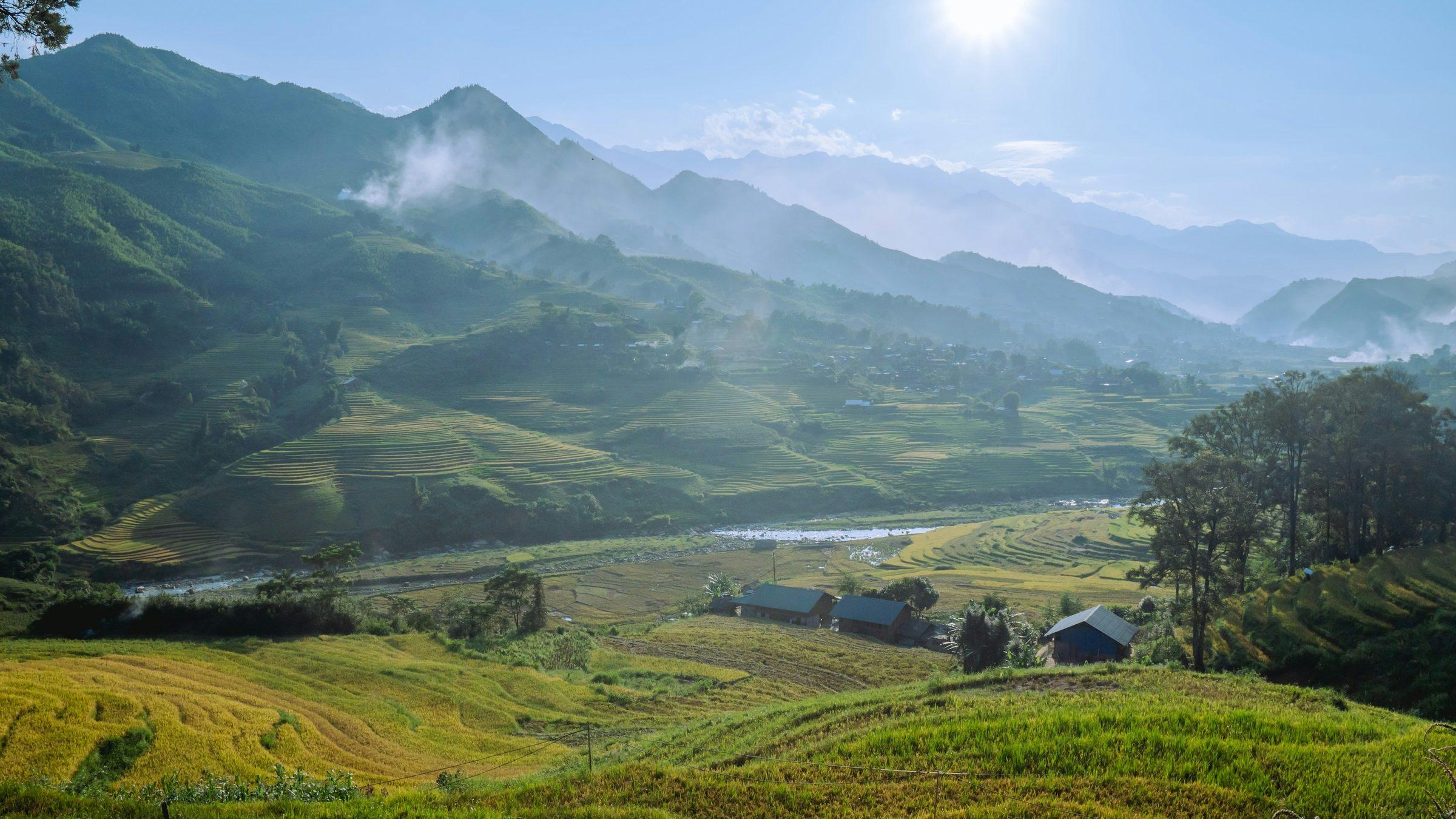
Sapa's rice terraces turn gold as the harvest nears, and the exact timing moves with altitude and the season's weather: expect the colour to build from late August, peak somewhere between mid-September and early October, and the harvest itself to run into October and November on the higher terraces. Guides disagree on the precise week, so a trip booked a month out is safer than one planned around a single reported date.
Winter is the other reason to visit. December and January are Sapa's coldest months: the town, at about 1,500 metres, sees daytime temperatures of roughly 8-15°C and nights closer to 3-6°C, while higher points such as Fansipan and Tram Ton Pass can drop to around freezing overnight. Snow is possible from December into late January, occasionally stretching into February, but it is not guaranteed in any given year and typically lasts only a day or two when it falls.
Tet 2027 and Vietnam in December
Tet, Vietnam's Lunar New Year, falls on Saturday 6 February 2027, starting the Year of the Goat; New Year's Eve, the evening with the most significance for most families, is Friday 5 February. The government sets the official Tet break each year, and the 2027 schedule had not been confirmed when we checked, so confirm the dates closer to the time. Around Tet, many family-run restaurants, shops and markets close for several days, transport and hotel prices rise in the week either side, and trains and domestic flights fill with people travelling home. Major sights and international hotels generally stay open.
December works well for two of the three regions: the north is in its cool, dry, comfortable stretch, and the south is just moving into its dry season. The centre is the exception, still clearing the tail of its flood season early in the month, though conditions usually improve as December goes on. A Hanoi-Hoi An-Ho Chi Minh City itinerary timed for late December, after the worst of the central rain but before the Tet rush in early February, is one of the more reliable combinations.
Getting from Dubai to Vietnam: flight times and the visa
Emirates flies non-stop from Dubai every day to both Hanoi (about 6 hours 45 minutes) and Ho Chi Minh City (about 7 to 7.5 hours). See our flight times from Dubai guide for how Vietnam compares with other destinations.
Nearly every UAE resident needs Vietnam's e-visa, applied for online before travel; it costs USD 25 to 50 and allows up to 90 days. Our Vietnam visa guide for UAE residents has the full process, and Vietnam visa services can handle the application for you.
Which UAE holiday fits a Vietnam trip
Eid Al Fitr 2027, expected on 9 or 10 March, is one of the better fits: the north is warming up, the centre is dry and the south is still in its dry season (see our Eid Al Fitr 2027 guide); see UAE public holidays 2027 for the exact dates once Ramadan's length is confirmed. Eid Al Adha, expected Saturday 15 to Tuesday 18 May 2027, is short for covering all three regions in one trip, but suits a centre-only trip well, since Hoi An, Da Nang and Hue are still dry through May. The UAE's summer break, June to August, lines up with the centre's best beach weather but lands in the wet season for the north and south. National Day (2 and 3 December) and the UAE's winter school break, from mid-December to early January, give one of the steadier combined windows, since the north and south are both turning dry and cool while the centre's flood risk is easing.
Plan your Vietnam trip with Holidayys
Our Vietnam Heritage Journey, 8 days and 7 nights from Hanoi to Ho Chi Minh City, starts from AED 7,200 per person and is listed on our Asia holiday packages page. If you would rather build your own route around a specific season, such as Sapa's rice terraces or the Tet holiday, message us on WhatsApp at +971 4 589 0001 or use the contact page and we will check flights, hotels and the visa timeline together.
Frequently asked questions
What is the best month to visit Vietnam overall?
For a trip covering north, centre and south, late November to mid-December or March avoid the worst of each region's wet season. If you are visiting only one region, its own dry season (October to December in the north, February to July in the centre, December to April in the south) is the simpler guide.
Is Vietnam good to visit in December?
Mostly. The north is cool and dry, and the south is moving into its dry season, but the centre is still clearing the tail of its flood season early in the month, usually improving as December goes on.
When is Tet 2027 and what closes?
Tet 2027 falls on Saturday 6 February. Many family-run shops, restaurants and markets close for several days around it, and transport and hotels get busier and pricier in the surrounding week; major sights and international hotels usually stay open.
How long is the flight from Dubai to Vietnam?
Emirates flies non-stop, about 6 hours 45 minutes to Hanoi and about 7 to 7.5 hours to Ho Chi Minh City.
When should I avoid central Vietnam (Hoi An, Da Nang, Hue)?
September to December, when typhoon risk and flood risk both peak, usually in October. The region's dry season, February to July, is more reliable for Hoi An's old town and Da Nang's beaches.
Do UAE residents need a visa for Vietnam?
Nearly all do, through the e-visa applied for online before travel. See our Vietnam visa guide for the current fee and process.
Related guides
- Vietnam visa for UAE residents
- Flight times from Dubai
- Best time to visit Thailand
- Best time to visit Japan
- Weekend getaways from Dubai
Last checked 9 October 2026 against Tet 2027 holiday reporting in Vietnamese and regional news, Quang Ninh's Ha Long Bay storm-season advisories, Vietnamese tourism and climate guides for regional weather patterns, and Emirates' published schedules for Dubai-Hanoi and Dubai-Ho Chi Minh City. Flight schedules, holiday dates and seasonal patterns change; confirm them closer to your travel dates.
- Vietnam
- Best Time to Visit
- UAE Residents
- Asia