Destination Guides
Cherry Blossom Season in Japan 2027: When and Where to See Sakura
Japan's 2027 cherry blossom forecast isn't out yet. Here are the average and 2026 actual bloom dates for 9 cities, the best viewing spots, and how Eid al-Fitr 2027 lines up with the bloom.
By Noushad Eranniyan8 min read
On this page · 11 sections
The short answer: no forecaster has published a 2027 sakura forecast yet (Japan's forecasters, the Japan Meteorological Corporation, Weathernews and tenki.jp, normally release their first guesses in January). Based on 30-year normals, Tokyo's cherry blossoms usually first open around 24 March and reach full bloom around 31 March, with Kyoto and Osaka a few days later and Hokkaido not until May. In the actual 2026 season, blossoms opened earlier than normal almost everywhere, with Tokyo's first bloom on 19 March and full bloom on 28 March. Eid al-Fitr 2027 is expected around 9 to 10 March, which falls before most of the bloom on Honshu.
| City | Normal first bloom | Normal full bloom | 2026 actual full bloom |
|---|---|---|---|
| Tokyo | 24 March | 31 March | 28 March |
| Kyoto | 26 March | 4 April | 30 March |
| Osaka | 27 March | 4 April | 3 April |
| Hiroshima | 25 March | 3 April | 30 March |
| Fukuoka | 22 March | 31 March | 3 April |
| Kanazawa | 3 April | 8 April | 3 April |
| Sendai | 8 April | 13 April | 4 April |
| Sapporo | 1 May | 6 May | 24 April |
| Naha, Okinawa | 16 January | 4 February | 3 February |
"Normal" is the Japan Meteorological Agency's 1991-2020 average for each city's reference tree, almost always the Somei-yoshino variety (Naha uses the earlier-flowering Kanhizakura). This is our deeper dive on sakura timing and viewing; for Japan's other seasons, see our best time to visit Japan guide to autumn colours, snow and the rest of the year.
Why there's no 2027 forecast yet
As of 4 November 2026, Japan's main forecasters had not issued a 2027 cherry blossom forecast. The Japan Meteorological Corporation, Weathernews and tenki.jp each publish a first guess in January, based on autumn and winter temperature trends, and refine it through February and March as spring warmth builds. If you're booking now, work from the normals and last year's actual dates below, and check for an updated forecast once you're within two to three months of travel.
Average bloom dates by city
On Honshu, Japan's main island, sakura generally moves from south to north and from low ground to high: Fukuoka and Hiroshima bloom first, in the second half of March; Tokyo, Kyoto and Osaka follow within a few days; Kanazawa and Sendai are roughly a week to two weeks behind Tokyo; and Sapporo, in Hokkaido, doesn't reach full bloom until early May on average. Okinawa is the outlier at the other end of the calendar: its Kanhizakura (a different, deeper-pink species) blooms in January, months before anywhere else in the country.
2026 was a notably early year almost everywhere in the table above, Tokyo's full bloom arriving three days ahead of normal and Sapporo's more than a week early, which fits a broader recent pattern of earlier blooms as Japan's winters and springs warm. Treat the normal dates as a guide to the order cities bloom in, not a guarantee of this exact date in any given year.
How long the blossoms actually last
Full bloom doesn't mean a long window. A tree is usually at its best for about a week from full bloom before petals start falling, and a spell of rain or wind can shorten that to a few days. Many visitors plan to arrive a day or two before a city's expected full bloom, giving a buffer if the trees peak early, and treat the whole "around full bloom" period, roughly ten days to two weeks, as the realistic viewing window rather than a single date.
Where to see sakura, city by city
Tokyo
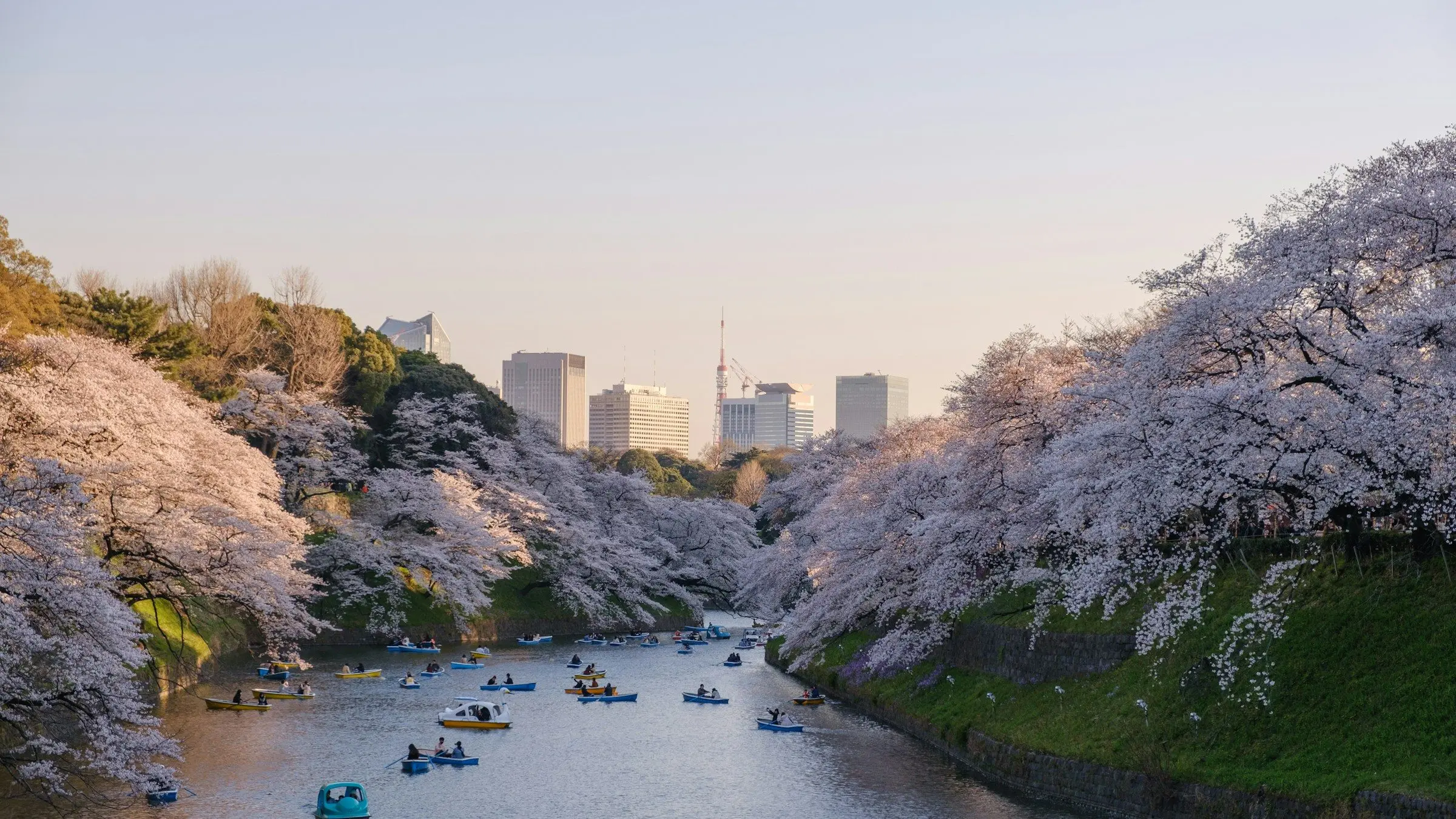
Shinjuku Gyoen has the widest range of cherry varieties and the longest viewing season in the city, since different trees peak at slightly different times. Ueno Park is the classic, crowded hanami spot, lined with food stalls. Meguro River is a long avenue of trees over the water, best in the evening when it's lit up. Chidorigafuchi, beside the Imperial Palace moat, is popular for rowing boats under the blossom and for its night illuminations.
Kyoto
The Philosopher's Path (Tetsugaku-no-Michi) is a quiet canal-side walk under cherry trees between Ginkaku-ji and Nanzen-ji. Maruyama Park has Kyoto's best-known single tree, a large weeping cherry, plus food stalls and evening lantern light. Arashiyama, on the city's western edge, combines blossom with the bamboo grove and the river, best reached early before the day-trip crowds arrive from Osaka.
Beyond Tokyo and Kyoto
Himeji Castle, Japan's best-preserved original castle keep, sits inside a park with around a thousand cherry trees and is reliably photogenic against the white walls. Hirosaki Castle, in Aomori in the far north, blooms later, around late April, and is widely rated one of Japan's best cherry blossom parks precisely because it peaks after the rest of the country has finished. Yoshino, south of Nara, is planted with an estimated 30,000 trees across a mountainside, blooming in a slow wave from the base to the summit over a couple of weeks.
Hanami etiquette
Hanami, literally "flower viewing," usually means a blanket or tarp spread under the trees with food and drink, not just a walk-past. If you want a spot under a popular tree on a weekend, arrive early; some parks allow reserving a patch earlier in the day, others don't. Take your rubbish with you, since bins are scarce in parks during the season, and avoid touching or climbing branches for photos, as the trees are planted close together and easily damaged. Drinking in public parks is generally tolerated during hanami, but keep it low-key, and expect train carriages near big parks to be full in the early evening as the day's hanami groups head home.
Booking from the UAE: timing and flights
Emirates flies non-stop from Dubai to Tokyo (both Narita and Haneda) and to Osaka Kansai; Etihad flies non-stop from Abu Dhabi to Tokyo Narita. Dubai to Tokyo is roughly 9h45 non-stop; expect a broadly similar flight time from Abu Dhabi. Hotel rates in Tokyo and Kyoto rise sharply in the two to three weeks either side of full bloom, and rooms in popular areas sell out early, so most agents recommend booking flights and hotels four to six months ahead for a late-March to mid-April trip, earlier still if you want a specific hotel near Shinjuku Gyoen or the Philosopher's Path.
For UAE families, the timing is awkward this cycle: Eid al-Fitr 2027 is expected around Tuesday 9 or Wednesday 10 March (the UAE holiday itself running three or six days depending on whether Ramadan is 29 or 30 days, and both the date and length depend on moon sighting). That falls two to three weeks before Tokyo, Kyoto and Osaka's average bloom, so an Eid trip timed for sakura is a gamble on an unusually early year rather than a safe bet. A UAE spring school break in late March or early April lines up far better with Honshu's bloom than Eid does.
Visa for UAE residents
Whether you need a visa for Japan depends on your passport, not your UAE residence. Emiratis with an ICAO-compliant e-passport can travel visa-free for up to 90 days. Most other UAE residents, including Indian, Pakistani, Filipino, Egyptian, Bangladeshi and Sri Lankan nationals, need a visa, and most can now use Japan's eVisa for a single-entry tourist trip, applied for through VFS Global in Dubai or Abu Dhabi. See our Japan visa from Dubai guide and Japan visa services page for fees, documents and processing time.
Before you go
Build a buffer day or two into any sakura-timed trip: the flowers move with the weather, not the calendar, and a late cold spell or an early warm spell can shift bloom by a week either way, even this close to travel. If one city's trees have finished, chase the bloom north or to higher ground, since Sendai, Hirosaki and Hokkaido all peak later than Tokyo and Kyoto. Pack a proper jacket regardless of the forecast: late March and early April evenings in Tokyo and Kyoto are still cool, and hanami picnics run into the evening.
Frequently asked questions
When is cherry blossom season in Japan in 2027?
No forecast has been published yet; the first 2027 forecasts are expected in January. Based on 30-year averages, Tokyo and Osaka typically reach full bloom in late March to early April, with Kyoto a few days behind and Hokkaido not until May.
How long do cherry blossoms last?
A tree is usually at its best for about a week from full bloom, though wind or rain can shorten that. Treat the ten days to two weeks around a city's average full-bloom date as your realistic viewing window.
What is the best city to see cherry blossoms in Japan?
There's no single best city: Tokyo and Kyoto both have several excellent spots and the most convenient international flights, Himeji pairs blossom with a dramatic castle, and Hirosaki and Hokkaido suit anyone travelling later, into late April or May.
Does Eid al-Fitr 2027 fall during cherry blossom season?
Mostly not. Eid al-Fitr 2027 is expected around 9 to 10 March, two to three weeks before Tokyo, Kyoto and Osaka's average full bloom in late March and early April.
How far ahead should I book a sakura trip from the UAE?
Four to six months ahead for flights and hotels is the usual advice, since hotel rates in Tokyo and Kyoto rise sharply around full bloom and rooms in popular areas sell out early.
Do UAE residents need a visa for Japan?
It depends on your passport rather than your UAE residence. Emiratis can travel visa-free; most other UAE residents need a visa, and most nationalities can now apply for Japan's eVisa through VFS Global in Dubai or Abu Dhabi.
Plan your sakura trip with Holidayys
Our Highlights of Japan group tour covers Tokyo, Kyoto, Osaka, Hiroshima and more over 13 days, and its 4 to 16 April 2027 departure sits inside the typical early-to-mid-April bloom window for most of Honshu (an earlier late-March departure that overlapped peak bloom is already sold out, which shows how fast sakura-season seats move). For a shorter, flight-inclusive trip to the three main cities, see the Ultimate Japan Adventure package, or compare every current Japan package on our Asian holiday packages page. We can also arrange flights and hotels around your own dates if you want to time a trip more tightly to a forecast once one is published.
Message us on WhatsApp at +971 4 589 0001 or use our contact page to start planning.
Related guides
- Best time to visit Japan: month by month
- Japan visa from Dubai
- Japan visa services
- Highlights of Japan tour
- Where to travel in January from the UAE
Last checked 4 November 2026 against the Japan Meteorological Agency's published 1991-2020 normal bloom and full-bloom dates and its 2026 observed dates for Tokyo, Kyoto, Osaka, Hiroshima, Fukuoka, Kanazawa, Sendai, Sapporo and Naha, Wikipedia's current Emirates and Etihad destination lists for Japan, holidayys.com's own flight-time, best-time-to-visit-Japan, Japan visa and Eid al-Fitr guides, and the Highlights of Japan tour page for its 2027 departure dates. No 2027 bloom forecast exists yet; Eid al-Fitr 2027's date depends on moon sighting and may shift by a day. Bloom dates, like all weather-driven dates, can move by a week or more from the normals in either direction, so confirm closer to travel.
- Japan
- Cherry Blossom
- Sakura
- UAE Residents
- Destination Guides